Thursday, February 27, 2014

"Why won't this Pain go away?"

In the field of physical therapy, there's been a growing trend of two groups of thought regarding pain:

1) the classical "structural" point of view (i.e. poor postural alignment leading to pain)

2) the neuroscience/pain science view where pain is a brain output.

And yet a third group is emerging that is somewhat of a "middle path" that is both #1 & #2.

The middle path isn't as popular, perhaps since being in the middle isn't as charged as polar opposites. Some people need identity (the "charge") through their tightly held beliefs which separates them from any opposing view.

Gratefully, I see the middle path is growing more each day since seeing both sides of a coin allows us to experience the Whole coin.

And this is Understanding.....


Below is a post I made on my personal FB page:

Pain is a brain output. In other words, it's a thought, and like all thoughts, pain is a limiting belief based upon past experiences and conditioning.

Our thoughts separate us from Reality and what we perceive as reality.

In this respect, pain is more of the Messenger.

It's not simply that the pain you experience is "all in your head". It's so much more than this. It can be from that "herniated disc" that an MRI revealed, or it can be related to that "forward head posture" from sitting eight hours a day, and it can also be so much more than a structural "fault".

It's a call to pay Attention. The Messenger is telling us to pay Attention to something that we've neglected or were too distracted to attend to.

But what do we tend to do to the Messenger?

Blame it, kill it, avoid it, or run away from it. In other words, refuse to Listen to It.

What is it that we do not want to hear?

Perhaps the Truth to who we are?

I don't know.


Friday, February 21, 2014

Got ITB issues?

Common gluteus minimus trigger point referral patterns

Often times when someone says they have "ITB issues", it's not so much that the iliotibial band (ITB) is at fault as it is it's a compensation for something else that's going on. And although there can be a lot of other possibilities to why the ITB can be affected, it can be as simple as some stubborn trigger points in the gluteus minimus muscle of the hip joint.

As you can see in the picture, the red areas represent the common referral pattern of a gluteus minimus trigger point (denoted by the "x") which coincides with the full length of the ITB.

Now you can simply treat the trigger point for some temporary relief (if that's what is causing your symptoms), but it's probably a better idea to address the movement pattern impairment that started the trigger point in the first place. One can think of a trigger point as the nervous system's way to create soft tissue stability in an unstable function.

Always a great idea to get assessed ;)

Wednesday, February 5, 2014

My Kneecap Keeps "Popping" Out

Dislocated patella
It's very common when presented with a history of one's kneecaps "popping out" for a doctor to refer the patient for physical therapy with a prescription of "Knee Strengthening/Quadriceps Exercises" and "ITB Stretching".

The medical term for this situation is "patellofemoral instability", where the patella (kneecap) has a tendency to sublux (or even dislocate) as it glides over the femur (thigh bone). I like to explain this to patients as if a train (your kneecap) is coming off of its tracks due to poor alignment.

Your patella derailing off your femur

Why does this happen?

Despite what conventional wisdom would tell you that it's weak muscles around the knee that cause the instability, it's actually a bit more involved. The usual suspects in conventional thinking to "blame" are a "weak" vastus medialis obliquus (VMO) and a "tight" iliotibial band (ITB).


In reality, the cause is more functional in that you can think of the knee joint as the middle man in-between the hip/pelvis above and the foot/ankle below. And like all middle men, they react to what's going on with the opposite ends of the chain.

When the patella subluxes, or "goes out of place", it's usually lateral of the femur. In not so severe cases, because the soft tissue structures involved are still contained, the patella usually glides back into place with a straightening and bending motion of the knee (i.e. it falls back into its track)

When the pelvis is in a less than ideal position, it will affect the function of the hip joint which will affect the function of the knee joint below. Likewise with the positioning of the foot and ankle can affect the knee joint above.

You can think of the pelvis/hips as the steering wheel, the knee and the foot/ankle as the wheels. What happens when your steering wheel is out of alignment? More wear & tear of the wheels.

Here's a typical clinical presentation:

The pelvis on the same side of the involved knee is either rotated too far forward or backward, with either way, there's a compensation at the knee where the femur (thigh bone) either wants to roll inward excessively or can't roll inward enough. Either way, the vastus lateralis (VL) quadricep muscle can be overly worked to maintain  a stable amount of internal rotation of the femur. Because the ITB covers the VL, it commonly is mistaken as the "culprit". And because the VMO wants to do the opposing motion of external rotation of the femur, it is often "out-classed" by the VL.

Can you see now why doctors prescribe "quadriceps strengthening" and "ITB stretching" for patellofemoral situations?

Everything's connected
The moral of the story is that everything is connected and with patellofemoral instability situations, I find what works is addressing what's going on above (more than below) the knee joint. Obviously every case is unique and I could go on about many other possible relationships, but what it comes down to is what is the primary driver, or the "Mother", behind the clinical presentation and the only way to find out is through a thorough clinical evaluation along with a barrage of assessment/reassessments of function.

So the next time you're in the Greenwich Village and/or Union Square neighborhood, consider coming by Michael Jocson Physiotherapy for a check up. You'll be glad you did.....
:)

Tuesday, January 21, 2014

Michael Jocson Physiotherapy now accepts insurance!


For 2014, I've decided to get involved with insurance companies again. It's been awhile and I chose not to "ever do this again", but as they say, time heals. With the advent of the Affordable Care Act, aka Obamacare, times have changed and so do we, no matter how much we try to fight it.

Here's a list of the insurance companies that I've presently contracted with (and currently awaiting for my enrollment to activate; this is why I'm not listed on their website provider directories yet since it takes 30-60 days) as an in-network provider:

Medicare (pending)
United Healthcare (pending)
Oxford Freedom (pending)
1199 (pending)
Multiplan (pending)
PHCS (pending)
Beech Street (pending)
Magnacare (pending)
GHI/Emblemhealth (pending)
No-Fault
Workers Compensation

*Until pending notification from the specific insurance company, I am considered an out-of-network provider (if applicable)

I can also work with you as an out-of-network provider if your insurance plan applies. The way this works is once we verify your out-of-network benefits (deductible, max visits, percentage plan pays, etc), you pay me my rate for each visit; I provide you with a receipt and CMS-1500 claim form in which you submit/mail to your plan. Your plan sends you a check for the percentage they cover (typically anywhere from 50-80% of the total charges).

So except for me being a nice guy, I'm actually a pretty decent therapist and now that I work with insurances, I am much more accessible to those who thought they could "never afford me". The bottom-line is that I truly love what I do and I am here to serve you, the patient, the Individual.

Wednesday, January 1, 2014

Happy New Year from Michael Jocson Physiotherapy!


With 2014 being the second year that I opened my practice in Union Square, I am offering the following specials:

- "Three for Two", or 3 sessions for the price of 2 regularly priced session.

- Treat & Train Monthly Membership Program - up to two sessions a week for a month.

- 10% discount when you sign up for a three month commitment ($240 savings)

Also, if your job offers a Health Savings Account program, you may be able to use it towards payment of my physical therapy services (not personal training).

Got questions? Contact me at mjocs@aol.com 

As you can see, it's now easier than ever to see me. No more waiting on the fence. "Physical therapy" and "Personal Training" catered for the Individual's needs. They're in quotes because I'm not your typical physical therapy and personal training practice ;)

Be Kind....
Be Awesome....


Wednesday, November 6, 2013

New Ligament Found in the Human Knee? So What?

The Anterior Lateral Ligament (ALL)
All over the internet on social media websites such as FaceBook and Twitter there's a popular buzz about a new found ligament "discovered" in the Human knee. This was from a study by some Belgium surgeons who found a consistent presence of the ALL in all but one of forty-one cadavers.
In reality, a Dr. Paul Segond, a French surgeon was the first to document a description of the ligament back in 1879. Obviously, like the conquistadores of Europe "discovering" the Americas, this "discovery" is more like a renaming. In the Belgium study, it states that probably about 97%-100% of us have this ligament. Previously many have thought of it as an oblique band of the lateral collateral ligament (LCL) or a lateral extension of the knee joint capsule.

What does this new "discovery" mean?

Honestly, nobody really knows. But there's some speculation that the ALL has a role in anterior cruciate ligament (ACL) injuries and its potential role in limiting internal tibial rotation as seen in positive pivot shift testing. For now we can just guess based upon our current understanding of the biomechanics of the knee along with the rest of the body.

My Take On This:

If the ALL checks internal tibial rotation and if it's injured, like all ligamentous injuries, the common approach is to facilitate the agonist muscle around the ligament to check further stretching/tensioning of the ligament. For example, the ALL limits internal tibial rotation and the biceps femoris contributes to the opposing external tibial rotation movement; so it makes sense to condition the muscles that externally rotate the tibia: biceps femoris, TFL, vastus lateralis. Theoretically, if the ALL limits the tibia moving internally on the femur, it can also limit the femur moving externally on the tibia and addressing the muscles that internally rotate the femur may also help stabilize an injured ALL: TFL, ischiocondylar adductor magnus, anterior gluteus medius/minimus.

But regardless of these specific muscles that directly affect the transverse plane of the knee and counters the internal tibial rotation tension that the ALL restricts, you'd also want to assess the function of the popliteus:
Popliteus
The popliteus actively contributes to unlocking the knee, internally rotating the tibia, and externally rotating the femur. Its actions of rotating the tibia internally and rotating the femur externally actually create more tension on the ALL. And what muscle do I see pretty much all the time being facilitated and loaded with gnarly trigger points post-knee surgeries? The popliteus, of course. Disengage the popliteus and you decrease the tensional load on the ALL. Pretty simple, huh?

But if you really want protect the ALL, ACL, the menisci, the patella-femoral joint and all the other structures around the tibia-femoral and tibia-fibular joints, assess what is going on up north at the pelvis. The pelvis-femur complex is like the steering wheel and everything below are like the wheels. If your steering is out of alignment, your wheels get much more wear and tear for every mile driven. This is a whole other story and blog post altogether but it is highly recommend to address the function of the pelvis and hip complex in three planes of motion.

Hopefully you got something out of this post and perhaps it helped spark some outside of the box thinking. Please share this with others since no one else appears to be writing about the ALL other than it's some "new" ligament discovered.
;-)


Friday, November 1, 2013

November 2013 Specials

For the month of November, 2013, our special this month is a "Get 3 for the Price of 2" where you get three sessions for $350.00 (about 33% savings). Also, for new patients/clients, save $15 off the normal hourly session rate ($160/hour). Contact me at mjocs@aol.com if you're interested.

Wednesday, October 23, 2013

Rika Keck interviews Michael Jocson on the Talking Alternative Radio

Here's a link to a radio interview I did earlier in the year with Nutrition, Health, & Fitness expert Rika Keck of NY Integrated Health

Check it out:
Michael Jocson Interview

And thanks for listening :-)

Treat & Train Program at MJ Physiotherapy

The diaphragm: Breath is the first movement we address in the Treat & Train Program


Whether you have an injury or pain or neither, there’s always something to improve with your posture and the way you move.  We are constantly working against and with gravity and over time this can take its toll on our body, as well as our overall health. With movement, we have breath; with breath, we have Life. And to be able to move freely with little to no restrictions can enhance our Life experience. Don’t believe me? Just go sprain your ankle and see how quickly that can affect your quality of Life….

With the Treat & Train Program at Michael Jocson Physiotherapy, you can have reassurance that your program will meet your needs since it is based upon an individualized assessment, which looks at your structure and function. Every session is an assessment in and of itself; every exercise, every movement is an opportunity to learn more about your self. One of my goals in this program is to teach you to become the best therapist and trainer for your number one client,…..You!

This is a monthly program* which consists of up to two sessions per week (total of 8 per month**). More sessions per week can be added and priced accordingly.
Each session generally includes three aspects:
1)   Corrective Phase – This involves any corrective stretches, repositioning, manual therapy, mobility, or neuromuscular re-education activities.
2)   Training Phase – Individualized training program
3)   Recovery Phase – This involves decompression procedures such as stretching, repositioning, and/or manual therapy as necessary.

Although these three aspects logically build upon each other, they occur simultanuously (ie. Every movement is corrective, training, and recovery).

Who will  benefit from this program?
Everyone

To get started on your Treat & Train Program at Michael Jocson Physiotherapy contact me at mjocs@aol.com or FaceBook: www.facebook.com/michael.jocson.92

* Payments are to be made during the first week of every month
** Any unused sessions for the month must be rescheduled within a two week period; if not possible, those unused sessions will be forfeited.  

Wednesday, October 16, 2013

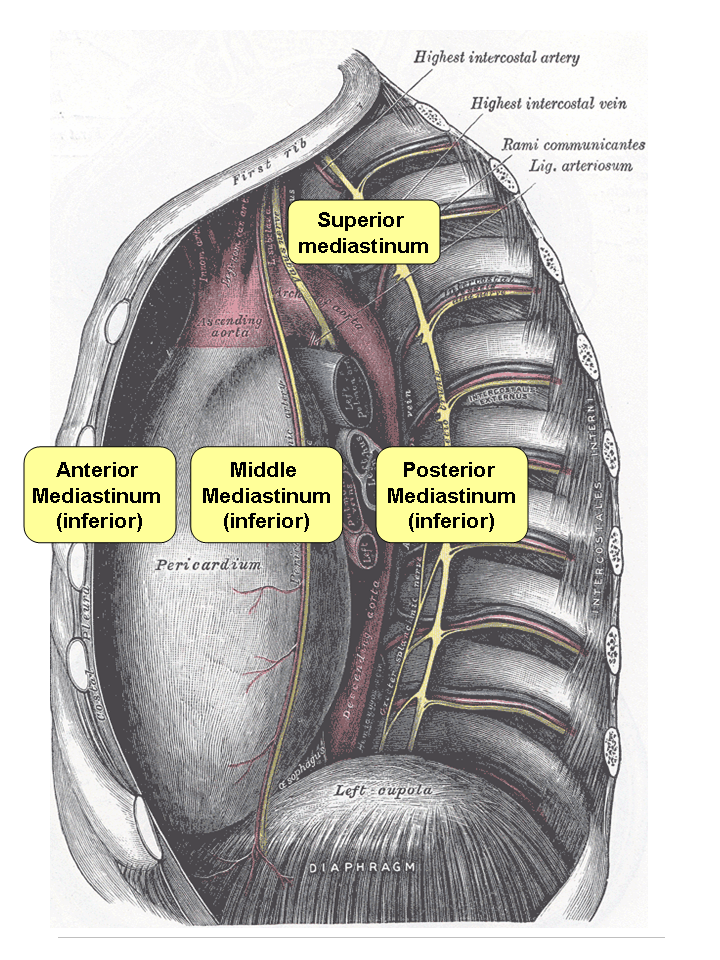
Posterior Mediastinum. Say What?


Okay. I know just from reading the title of this post many may start thinking this is going to be some sort of anatomy lesson with medical terms they’ve never heard of, nonetheless pronounce. No worries though, the word “mediastinum” is a term to describe the chest wall. For you science nerds who want to know more, go here. For the rest of us, just understand that this post is all about the chest wall, and more specifically, the chest wall around your back. And even more specific, the upper back. To have lower back pain is common and so is neck pain, but look who is in the middle,….the upper back.

The upper back is the middle man between the lower back and the neck and what lies on the upper back as if it is a saddle? The scapulae (shoulder blades). We can call the rear chest wall the posterior mediastinum and we can also include with it the posterior thoracic wall (for some anatomy nerds, they’ll point out that the two are separate but for simplicity’s sake, we’ll group them together). The thoracic spine (the spinal aspect of the upper back) with the rib cage attached to it plays a major role in dissipating loads from the lumbar and cervical spine as well as the shoulder complex. This area is also greatly involved with our breathing. Just look at any young child after they’ve been running around and you’ll see just how well the thoracic ribcage is involved with breathing.

I remember when I was in physical therapy school, we were taught that an excessive amount of kyphosis (a natural curvature of the thoracic spine) was not “good” posture and that “strengthening” the muscles around the upper back and shoulder girdle would take a load off of the neck and lumbar spine and shoulders. What was not as common (or at least emphasized in school) was the opposite, which is considered a flattened thoracic spine kyphosis (or flat spine for short). Both excessive (“hunchback”) and deficient (“flat back)) thoracic curvatures can contribute to aberrant stress to the rest of the body.

The posterior mediastinum and stress

Right around the posterior mediastinum and the posterior thoracic wall is the sympathetic chain which is a part of the sympathetic nervous system (SNS), or the “fight or flight” aspect of our autonomic nervous system. The sympathetic chain has connections to our organs that feed them info about stress. All the soft tissues of the upper back can affect the sympathetic chain. For example, a lack of mobility of this area can increase the amount of tension and thus stress to the nerve tissue. Of course you’re not going to die from this, but in theory, it’s an extra physiological load on your bodily systems. It is common for people to lack flexion in this area and an increase in extensor tone of the spinal muscles can facilitate a sympathetic stress response with an over active diaphragm muscle which in turn functions more as a postural stabilizer as well as a respiratory muscle. The result is a deficient breathing pattern where the anterior and superior aspects of the lungs and chest wall are expanded leaving the lateral and posterior aspects “flat”. Take a deep breath right now and notice how much you raised your shoulders or sat up tall (extension) with your inhalation. I bet you didn’t feel any air going into your upper back?  Not convinced this area is important? Check out this link where a study of patients who underwent surgery for instrumentation for scoliosis correction and had damage to the sympathetic chain and experienced changes in temperature perception and perspiration.

When you perform a lot of overhead weightlifting activities, you’re basically facilitating a constant stress response as far as posture is concerned and decompression of the area is necessary to balance the soft tissues and lessen the tensional load on the sympathetic chain. One simple self-help way to decompress is to improve your ability to flex the thoracic spine.

Seated Wall Reach

Sit up against a wall with your buttocks and lower back up to about bra strap level in contact with the wall. Pull your knees towards you with your feet as close to your hips as comfortably as possible. Place your arms over your knees and reach forward. Exhale and reach forward. Inhale and remain where you are. Every time you exhale, reach a little more forward and every time you inhale, imagine filling up the upper back area up with air (which should be comfortably off the wall with the reach movement). Perform 4-5 breaths and then rest. Perform 3-4 sets of this.

Now that you are armed with this new information, you can apply it to any exercise; especially exercises where the spine is in full extension and loaded. Just imagine filling the posterior chest wall up with air every time you inhale to help mobilize the area and offset any common stiffness of the upper back.

Tuesday, October 15, 2013

October is National Physical Therapy Month....

Not only is October National PT Month but October 29th is also the one year anniversary of Hurricane Sandy and as many of you who know me, that experience has changed my Life and practice. If it wasn't for Hurricane Sandy, I probably wouldn't have a practice in Manhattan right now.

So in lieu of this being October, I am offering a really sweet deal for new patients and old ones whom I haven't treated within the past six months. This is for those who always thought they couldn't afford my services but were interested in the type of work I do. For more details, please contact me at mjocs@aol.com.


Wednesday, August 14, 2013

Quick Video For Neck Pain


Ever notice when you have some neck pain or even a stiff neck and it becomes difficult when you drive, especially when you have to park or back up?

Recent Review From A Patient

Below is a recent review from a patient who was so kind to share:


"A year ago, I was diagnosed with a frozen right shoulder which was recalcitrant to the usual medical management
and physical therapy.  Five months later without much progress, I decided to have surgery which helped with mobility but not the persistent pain despite
NSAIDs, icepacks, Percocet 2 tablets every 4 hours and more intensive physical therapy.  Another 4 1/2 months passed and I was in a standstill, I could barely raise my arm to shoulder level and still in so much pain. The goal is for me to raise the arm above the head to get cleared for work. It was then that I decided to find Michael as recommended by a  previous patient who has been raging about him.   I then googled Michael's name and found out about his office in Manhattan. It's quite a travel from Queens and payment is on a cash basis. At that time I was desperate, I was out of job for 9 months and was told that I will lose my job as a Nurse Practitioner in a local hospital in Queens if I do not return in another 3 months. I called Michael that day and immediately started on an entirely new physical therapy experience. He treated me as a whole human being and not just "a part". With few maneuvers, Michael diagnosed that I have left hip weakness that is more likely contributing to my shoulder problem as a "compensatory mechanism".
Within 3 sessions I was able to raise my right arm above my head and eventually tapered off all of my medications. In two months I was finally back to work and managing with the home exercises that Michael taught me. I am still seeing Michael once a week while am adjusting to my workload but doing just great!"
 
Merla Repato, RN, MSN, CCRN, APRN-BC

Monday, August 12, 2013

Occasional Sacroiliac Joint Discomfort


You may not have any "significant" complaints of sacroiliac joint (SIJ) pain (that area where your tailbone meets your pelvis), but you can seem to reproduce some discomfort when you're in certain positions such as after prolonged sitting activities such as sitting in front of your computer such as what you are doing right now. Now let's say that when you fully slouch, or tuck in your butt, you start to feel some discomfort in the SIJs; and let's say you move your pelvis in the opposite direction where you're sitting taller and sticking your butt out and you also feel some discomfort. I bet if a therapist stuck their thumbs in that vicinity, they'd find the "speed bumps", or areas of fibrosis, which is  the body's response to excessive, prolonged soft tissue stress where it thickens the involved tissues. The sacrum and the ilium of the pelvis move all over the place and their structure (form) and the muscles around them (force) provide for stability in what's called form & force closure. When the positioning of the joints are less than ideal or if certain muscles are not working when they need to be, you get a case of "instability". And instability of the SIJs can be compensated everywhere else throughout the body. Just imagine the stereotypical "sexy" woman gait pattern where the hips sway excessively side to side and how this can contribute to possible ankle sprains, knee pain, low back, neck, and shoulder issues as well.

Now getting back to that discomfort in your SIJs when slouching and sitting up tall:


From the above picture, you can see the relationship between the gluteus maximus (butt) and the opposite side latissimus dorsi ("lats"). For example, look at the right butt and go diagonally up towards the left shoulder; you'll notice how the muscle fibers flow together in an oblique fashion. This "butt" and "lats" relationship provides for force closure (stability) of the SIJ (in this example, the right SIJ). Whatever side discomfort you feel, contract that side buttock muscle and the opposite side "lat"(tighten your armpit or press your hand down into your lap); maintain your butt & lat contraction (while breathing), and slouch or sit up tall as you did before. What you'll notice is that your discomfort should be gone. This is because you're using the muscles in a way to protect the joint.


The genus of our body is that everything works together. The "butt & lat" relationship relates to how we developed the ability to walk where the opposite arm and leg move together. We run into problems when we no longer perform activities that stimulate our nervous system. In other words, we get lazy. And when we're lazy, we lose function,...the old "use it or lose it" phenomenon .

You'd be amaze at what your body can do once you spend some time exploring its potential....
You've got muscles. Now go use them.

;-)

Reference:
Vleeming, A et al. Movement Stability & Low Back Pain: The essential role of the pelvis. Churchill Livingstone, 1997: pp.231-233

Saturday, August 10, 2013

If You Like To Run: Work Your Hips!

I've treated a lot of runners over the years and one clinical pearl of advice I can give to running enthusiasts is to condition their hips. Every running injury I've ever treated had a component of hip dysfunction. Hip dysfunction could be in the form of hip joint hypo- or hyper mobility, muscle weakness, or instability. Or it can be something as simple as a lack of coordination of firing the right muscles at the right time.

Regardless of what kind of hip dysfunction is present, I'd recommend adding some kind of supplementary hip specific mobility, stability, strength, power, and proprioceptive training into your program.

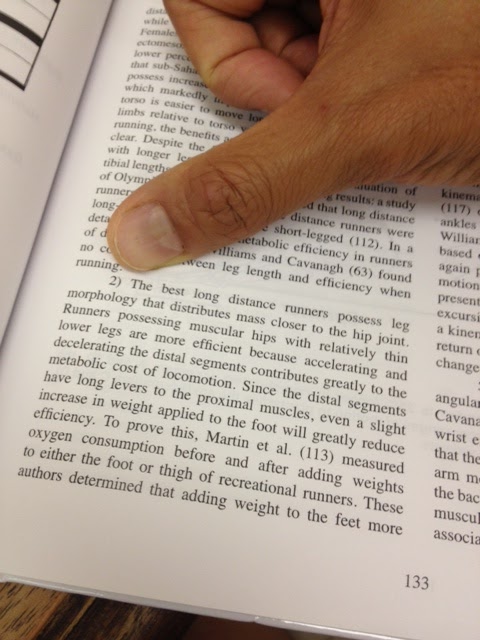
The following picture is from the book Human Locomotion: The Conservative Management of Gait-Related Disorders by Thomas C. Michaud on page 133:


It's interesting that he mentions that some of "the best long distance runners possess leg morphology that distributes mass closer to the hip joint." This is due to the high metabolic costs during running of accelerating and decelerating the lower legs. He cited a study where the authors added weight to the feet and found that it more than doubled the metabolic costs of locomotion:

Martin P, Heise G, Morgan D. The Relationships between mechanical power, energy transfers, and walking and running economy. Med Sci Sports Exerc. 1993; 25: 508-515.

And with long distance running, it's all about energy efficiency. As one fatigues, the body compensates, chances of injury increase.

The bottom-line:

If you like to run, work your ass.


Friday, August 2, 2013

Fascia & the Turkish Get Up


I made this quick video in response to a recent FaceBook discussion brought up by Joel Crandall of PhysioCareCenter in Los Angeles, California regarding the Turkish Get Up (TGU) movement. His question was brought up at a study group where a few were RKCs who were not able to answer his question of why some people say to dorsiflex the ankle of the bottom extended leg during the beginning of the movement. Some other RKC/StrongFirst trainers responded on the FaceBook thread that it's not so much the dorsiflexion of the ankle that's important as is the emphasis on pushing the heel away from you to create a stable point in which the movement can be transitioned. I talk about the possibility of the fascia creating the stability at the pelvis from the positioning of the extended leg from some courses that I took with Guy Voyer, DO.

I do want to emphasize that I am NOT a RKC/StrongFirst certified trainer nor do I currently train the TGU movement but I do study movement, health, and everything in between and I have and continue to treat injuries as a living. This is just me sharing a different perspective of the TGU relating it to the fascia. Enjoy!

Friday, July 26, 2013

The Iliacus: a LCF


From my training in Neurokinetic Therapy (NKT) with David Weinstock, David refers to the iliacus as a "LCF", which stands for Lower Cluster F**k, because of its common involvement as a facilitated compensator for so many other muscles throughout the body. For example, it is very common for the iliacus to compensate for a psoas or gluteus maximus or abdominal oblique muscles that aren't working as effectively as they can be.

So why is the iliacus commonly facilitated?

I don't know exactly, but my best guess could be it's location. The iliacus is a deep muscle that inserts to the upper two-thirds of the iliac fossa and inserts onto the lesser trochanter of the femur; it also has connections to the anterior aspect of the sacrum.


This means that it has its hands on several different joints: coxa-femoral, femoral-coxa, sacroiliac, and iliosacral. These joints are a part of the pelvic-hip complex which can also be viewed as a mid-point between the lower body and the upper body. Whenever there's a mid-point, there has to be a common ground, or "middle path" (as the Buddha would say), where a balance between the forces above and below take place. This balancing is a dynamic process and because the nervous system moves towards "stability" and avoids "instability", it tends to facilitate the deeper muscles (or muscles closer to the joint) in order to create a crude sense of stability through increasing joint compression when it senses an "unstable" process. From my experience, whenever I see a facilitated iliacus, it's common to see a compressed hip joint, an anteriorly rotated ilium, and a forward sacral base ipsilaterally. This can present itself clinically as femoral-acetabular impingement (FAI), forward sacral torsions, and/or iliosacral instability which presents symptomatically as pinching in the groin, hip pain, SI joint pain, low back pain, difficulty bending, walking, negotiating stairs, etc.

What happens if the iliacus is "inhibited"? No muscle is ever really fully inhibited; for lack of a better word, let's understand that when I say "inhibited", I mean a muscle that's not firing as effectively as it can be. David Weinstock mentions that it's rare to find an inhibited iliacus. But when you do, there's usually several layers of compensations going on. I usually see a multi-system overload and the "inhibited" iliacus is just the icing on the cake. Locally, it can be something as simple as positioning and functioning of the involved joints. For example, when there's a restriction in hip flexion and/or a restriction in anterior rotation of the ipsilateral ilium, the iliacus may test inhibited. To verify limited hip flexion involvement, one could muscle test the hip in less flexion after testing the involved iliacus in a shortened position and if it tests strong, limited hip flexion may be contributing to the inhibited iliacus due to arthrogenic inhibition. One can also test the psoas muscle and its inhibition is another way to verify hip flexion restriction. For iliacus inhibition due to limited anterior ilium rotation, one can test the quadratus lumborum and latissimus dorsi; these would test inhibited while the psoas would test strong. 

Sometimes we assume just because we are a more sedentary society and that we tend to sit a lot that the iliacus is always in a shortened position and that it can more easily be recruited in times of instability and over time it can develop trigger points, be facilitated, and even after a while, get "tired"and become weak due to fatigue. We never really know unless we assess its role in relationship to the rest of the body and overall tie it together with its integrated function during movement. Without movement the iliacus would never be considered a "LCF".....

Thursday, July 25, 2013

Red Velvet Chocolate Marshmallows


My son and I were watching the Cooking Channel the other night and there was some show that had a lot of dessert-type of dishes and one popular dessert is red velvet cake, cupcake, and many other variations. At the time I was thinking of making some marshmallows since I haven't them in awhile and then the lightbulb went off: Why don't I make some red velvet marshmallows?

Last year I had already posted a recipe for chocolate coconut marshmallows so a red velvet one would be similar with some obvious changes. Here's the ingredients I used:

Great Lakes Gelatin (orange can) - 6 tbs
Organic sugar - 1 1/2 cups
Organic red beet - 1/2 medium size (peeled & chopped)
Organic dried coconut chips (or flakes) - 1 cup
Organic powdered cacao - 3 tbs
Organic vanilla extract - 2 tsp

While I was making this, I realized that I used way too much cacao and that's why the marshmallows didn't turn out to be as red; but the extra cacao made a real deep chocolate flavor.
I basically used beet juice and coconut milk instead of water to mix with the other ingredients. To make the beet juice: place chopped beets into blender and add just enough water until covered. Blend. Pour blended mixture into a cheesecloth or nut milk bag, or do what I do if you don't have any of those, use a fine mesh strainer and strain the liquid (discard the beet solids). To make coconut milk: do the same as with the beets. Mix the beet juice and coconut milk together in the same container. Take one cup of this and let sit with the gelatin powder for about 10 minutes. While that is sitting, in a skillet or saucepan, heat another cup of the beet juice/coconut milk with the sugar to a gentle boil, or at least to a little thickening. Add the cacao powder and vanilla extract and boil some more. Next, pour this into the gelatin mixture and user a hand mixer to blend until desired thickness. This may take about 10-20 minutes depending on the power of the mixer you have but you don't want to mix too long that it's gets too thick. Pour the mixture into a greased container (I used a square glass pyrex greased with coconut oil), flatten and smooth the mixture, and store in the refrigerator for at least a few hours before eating.


Before serving, I sprinkled some sea salt onto a plate and coated the top surface of the already squared-cut marshmallows to give that sweet, chocolatey, salty taste, but that's just me. In the above picture I put the marshmallows into my Lunchbots container for work and as you can see I also have the green container of Great Lakes Gelatin in which I mix with orange juice as a post-work-out drink (I didn't want anyone to get confused which can to use for the marshmallows).

Enjoy!

Tuesday, July 2, 2013

Glenohumeral Internal Rotation Deficit (GIRD)


This is just a quick video where I demonstrate that limited glenohumeral joint internal rotation ROM is not necessarily from a "tight posterior joint capsule" that requires joint mobilization or stretches to improve internal rotation. If you do so without understanding and checking the relationships of the rest of the body to the involved shoulder complex, you risk creating a joint instability issue. I'm calling out physical therapists, chiropractors, or any bodyworkers, that do this type of treatment and probably have no idea that they're actually doing more harm than good for their patients....

Tuesday, June 25, 2013

Adverse Neural Tension


This was a quick video I made after work last night regarding a patient with symptoms of adverse neural tension of her right arm. Adverse neural tension means simply that the nervous tissue is being compromised somewhere along its span in the body to the point of expressing symptoms of numbness, tingling, or even pain. In this case, the patient had been to several medical specialists and had plenty of diagnostic work-ups that were all without any answers.
Enjoy...